Understand your requirement
Review hazards and foreseeable access for conveyor pull-wire stop systems, machine motion and stopping behaviour, and operating, cleaning and maintenance tasks using your samples, drawings and production observations.
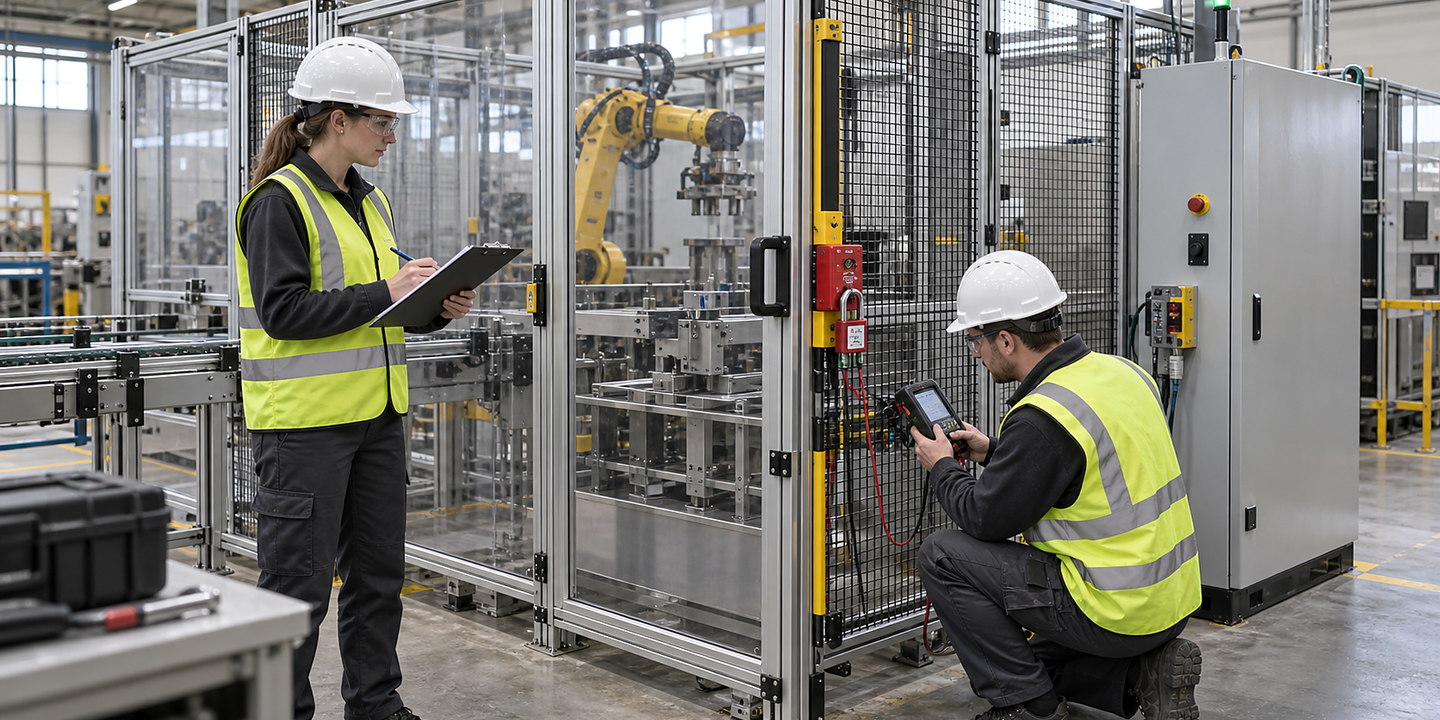
Compare practical options for conveyor pull-wire stop systems, including what each route needs, where it fits and what to check before you decide.
The right solution for conveyor pull wire stop systems is the simplest system that reliably handles your stated duty, line connections and expected exceptions.
Plan conveyor pull wire stop systems around your machine hazards, operator tasks, access, stopping behaviour and validation evidence. Discuss a site-specific safeguarding concept with Oxford Machine Guarding.
Plan conveyor pull wire stop systems around your machine hazards, operator tasks, access, stopping behaviour and validation evidence. Discuss a site-specific safeguarding concept with Oxford Machine Guarding. When you compare solutions, check how each option handles hazards and foreseeable access for conveyor pull-wire stop systems, machine motion and stopping behaviour and your surrounding line.
Discuss your application

Review hazards and foreseeable access for conveyor pull-wire stop systems, machine motion and stopping behaviour, and operating, cleaning and maintenance tasks using your samples, drawings and production observations.
Run focused trials for conveyor pull wire stop systems so you can see why an option is recommended or ruled out.
Resolve existing control-system architecture, space, visibility and operator ergonomics, controls, safety, operator access and maintenance before site work.
Check risk-reduction and validation evidence in normal, difficult and fault conditions, then agree training and support for your team.
Typical support: site survey, risk-led guard design, manufacture, installation and validation within an agreed scope.
| Approach | Often suitable when | Watch for |
|---|---|---|
| Conveyor Pull Wire Stop Systems | You need a dedicated solution for a clearly defined duty, product or part range and line interface. | A site survey and task-based risk assessment are required before a safeguard is selected. |
| Fixed Physical Guarding where Access Is Rare | Your volumes, product mix or operator judgement make a simpler route more practical. | Check ergonomics, consistency and safe access before choosing the lower-complexity option. |
| Interlocked or Presence-Sensing Protection where Frequent Intervention Is Foreseeable | Your surrounding process is stable enough for a broader automated solution to add value. | Allow for line connections, fault recovery and maintenance as well as the headline equipment. |